-.-
Railroads of the Mojave Desert
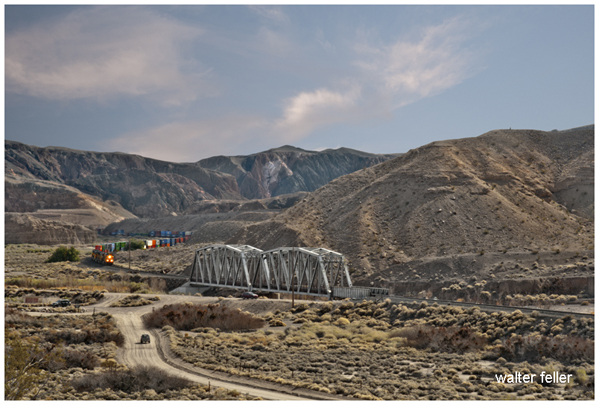
Afton Canyon
Railroads and Mining in the Mojave Desert and Southwestern Basin and Range, California and Nevada
Gregg Wilkerson and Larry M. Vredenburgh
Jan. 29 2024
ABSTRACT
Between 1876 and 2017, thirty-seven railroads were constructed in the Mojave Desert and southeastern Great Basin. The Southern Pacific built two early transcontinental routes through the study area: the San Joaquin line in 1876 and the Mojave-to-Needles line in 1883. Early transcontinental routes that were built through our study area were the Southern Pacific - San Joaquin line (1876), and the Southern Pacific (SP) line that linked Mojave to Needles (1883). The SP connected with the Atlantic and Pacific (A&P) at Needles (Topock), which had been built from the east to west from Albuquerque. Both lines reached Needles at nearly the same time. The Southern Pacific sold their line to the A&P in 1884. In 1885, the California Southern Railroad (A subsidiary of the Santa Fe) connected at Barstow with A&P, creating a new line to the port in San Diego through the Cajon Pass. In 1905, the San Pedro-Los Angeles and Salt Lake (which was purchased in 1921 by the Union Pacific) was completed from Salt Lake City to the port of Los Angeles, using track agreements with the Santa Fe for its line between Colton and Barstow. The Carson and Colorado (C&C) was originally planned to connect Carson City with Fort Mojave on the Colorado River. That destination changed to Tonopah, then Candelaria and finally to Keeler in the Cerro Gordo Mining District.
These railroads provided a transportation framework from which a network of railroads was later connected. These later railroads primarily served individual mines and mining districts. This report is a chronological description of railroad construction in relation to mining and mineral deposits in this area.
Following the 1848 discovery of gold in Coloma, California, on the American River, gold was discovered all along the western slope of the Sierra Nevada Mountains – as far west as Klamath Mountains. By the late 1850s, other mineral deposits were discovered east of the Sierra Nevada Range, eventually eastward into Nevada, the Mojave Desert and Arizona.
Construction of the main lines through our study area immediately provided transportation that was less expensive than the mule teams that predated them. Several short lines were built when mineral deposits were close to the main lines; however, distance and demand required the construction of several significantly longer rail lines. There were two long-line railroads dedicated to reaching the Bullfrog (Rhyolite) mining district: Las Vegas and Tonopah (1905) and Tonopah and Tidewater (T&T, 1907). The T&T’s primary designation was the Lila C. Mine in the Greenwater Range east of Death Valley.
Changes in United States monetary policy in 1893 and the exhaustion of high-grade deposits led to booms and busts that affected the railroads. Competition from trucks and automobiles also contributed to a reduction in demand for railroad services. Many went bankrupt or were assimilated or merged to survive. During WWII, almost all the mining-dedicated railroads in the Mojave Desert and Great Basin were scrapped for much-needed iron to support the war effort. With a few exceptions, only the original transcontinental lines remain in operation today. The Golden Age of the mine railroads that linked remote parts of this area is but a distant memory.
Needles: Santa Fe's Gateway to California
In the early 1880s, Needles became the point where the Santa Fe system reached California but did not yet control its own route across the state. Southern Pacific had built east from Mojave to Needles, while the Atlantic & Pacific approached from Arizona.The lines met in 1883. Through passenger service from the East began that fall, but Santa Fe traffic initially depended on Southern Pacific track between Needles and Mojave. Santa Fe had reached California, but it did not yet have a fully independent route to Southern California.
This was the central railroad struggle. Southern Pacific had built its Mojave-to-Needles line in part to prevent a competing railroad from establishing a separate route across California. Santa Fe accepted the temporary arrangement, but continued to seek a route it could control.
That route came through Cajon Pass. In November 1885, the California Southern completed its line from San Bernardino through Cajon Pass to Barstow, where it joined the Santa Fe's trans-Mojave route. Santa Fe then had a direct connection between Southern California and the East without depending on Southern Pacific service beyond Barstow.
Needles was also a difficult physical gateway. The Colorado River crossing was vulnerable to floods, and early wooden railroad bridges failed more than once before a stronger steel bridge was completed in 1890. The town grew as a crew-change point, river crossing, and eastern entrance to the Mojave Desert.
Mining and Industrial Railroads
The main lines crossed the desert, but smaller railroads reached into its mining and industrial districts.The Waterloo Mining Railroad, also called the Calico Railroad, carried silver ore from the Calico district to the Waterloo mills near Daggett. The Borate & Daggett Railroad later replaced mule teams hauling borax from the Borate mines. The American Borax or Columbia Railroad served borate workings near Lead Mountain and shared part of the Calico-area rail system.
Other branch lines served copper, gold, salt, gypsum, limestone, and chemical operations.
The Ludlow & Southern served mines and mills near Stedman and Bagdad.
The Randsburg Railway connected Kramer with the Rand mining district and Atolia.
The Mojave Northern Railroad carried limestone from quarries northeast of Victorville to the cement plant at Leon.
The Trona Railroad connected Searles Lake chemical works with the regional railroad network.
The Tonopah & Tidewater ran north from Ludlow through Baker, Soda Lake, Tecopa, Shoshone, and Death Valley Junction toward the Bullfrog district.
The Nevada Southern, California Eastern, Ivanpah, and Barnwell & Searchlight lines tied eastern Mojave and Nevada-border mines to major railroads.
Many of these lines were short lived. A mine could close, ore prices could fall, or truck freight could become cheaper than maintaining track across the desert. Yet their grades, sidings, trestles, depots, and abandoned roadbeds remain part of the Mojave landscape.
The modern Calico & Odessa Railroad should be treated separately. It is an interpretive tourist railroad built during the Walter Knott restoration era, not a surviving mining railroad on the original historic alignment.
Railroads, Water, and Towns
Water determined much of the railroad geography. Stations were placed where steam locomotives could take water, where crews could work, and where freight could be transferred. Springs, wells, riverbed water, and storage tanks helped determine the importance of Mojave, Daggett, Barstow, Ludlow, Kelso, Goffs, and Needles.Barstow became the central operating city of the Mojave railroad system. Its yards, shops, roundhouse, maintenance work, crew changes, and freight operations gave it a role larger than most nearby desert towns.
Daggett served as the Calico and Borate supply and shipping point. Rail freight reached Daggett, then moved north by wagon, stage, or narrow-gauge railroad to the mining districts. When silver declined, borax kept the connection important.
Railroad stations also supported eating houses, hotels, blacksmith shops, telegraph offices, stores, and repair shops. The Casa del Desierto at Barstow, El Garces at Needles, and Kelso Depot remain as major reminders of this working railroad world.
Legacy
Railroads helped establish the corridors later followed by highways, pipelines, power lines, and interstates. The Mojave Road, National Old Trails Road, Route 66, Interstate 15, and Interstate 40 all reflect the same practical geography of passes, water, grades, and open desert basins.Many branch lines have disappeared, but the main corridors remain active. BNSF freight trains still use the old Santa Fe route across the Mojave, while Union Pacific trains continue through Kelso and Cima. The Mojave Northern Railroad remains an industrial line serving quarry and cement operations.
The railroad story is not only about trains. It is the story of how the Mojave became connected: how mines reached markets, how towns gained supplies and people, and how a desert once crossed by wagon roads became part of a national transportation system. -->
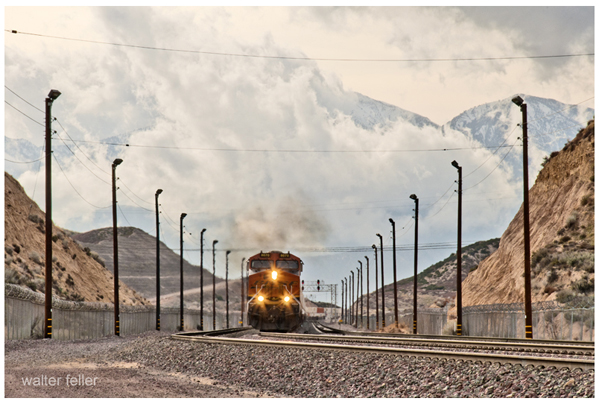
Cajon Summit
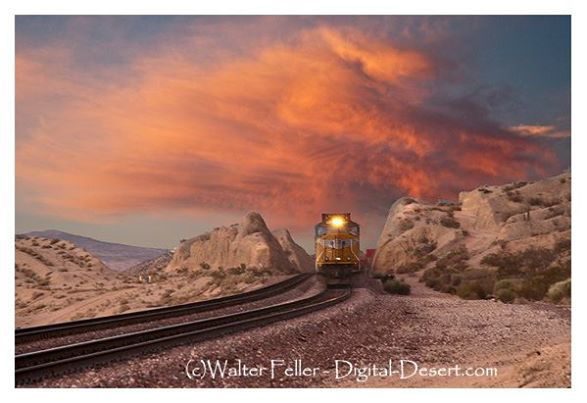
Helendale
Atlantic & Pacific Railroad
Barnwell - Searchlight
Calico - Odessa
Borate & Daggett
California Eastern Railroad/Railway
California Southern Railway
Carson and Colorado Railroad
Las Vegas & Tonopah
Ludlow and Southern
Nevada Southern Railway
Randsburg Railway
Santa Fe Railroad (Santa Fe Railway)
Southern Pacific
Southern Pacific - Jawbone
Tecopa RR
Tonopah & Goldfield
Tonopah & Tidewater Railroad
San Pedro, Los Angeles and Salt Lake Railroad
Bullfrog Goldfield
Yellow Pine Railroad
Death Valley Railroad
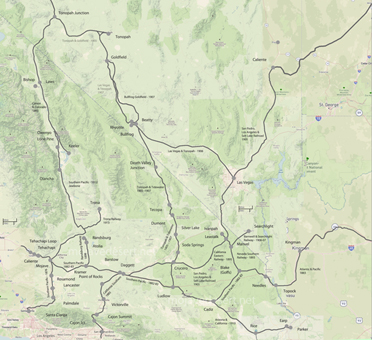
Map
Kelso Depot
Casa del Desierto
Garces Harvey House
Railroads of the Mojave Preserve
Defying Death Valley
Railroad Depots, Stations & Eating Houses
Railroading in Arizona, 1878-1949