Yellow Pine Railroad
Mormon miners began working the lead deposits at Potosi in 1856, establishing what may have been Nevada's oldest lode mine. Nathaniel V. Jones later directed another attempt to recover and smelt the ore, but technical difficulties limited the early operation. Mining resumed in 1861 and continued intermittently as operators pursued lead, silver, gold, copper, and eventually zinc.[1][2]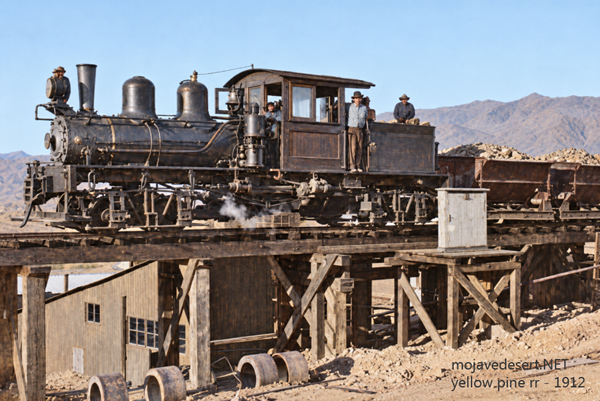
A mill built near Goodsprings in 1898 initially treated copper ore. The Yellow Pine Mining Company later acquired the property and expanded the mill with a concentrator to process lead and zinc ores. Completion of the Los Angeles and Salt Lake Railroad through Jean in 1905 lowered transportation costs and made the district's previously undervalued zinc deposits more profitable.[1][3]
Between 1910 and 1911, the Yellow Pine Mining Company constructed a three-foot-gauge railroad connecting the main line at Jean with Goodsprings, the mill, and nearby mines. The route between Jean and Goodsprings measured approximately 12 1/2 miles. Workers built much of it with secondhand rail and equipment obtained from the abandoned Quartette Mine Railroad near Searchlight.[3][4]
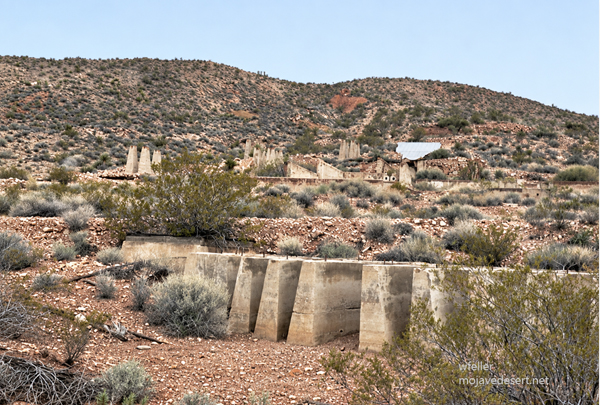
The railroad hauled ore from the mines to the Goodsprings mill and carried concentrates from the mill to Jean for shipment over the Los Angeles and Salt Lake main line. It also brought machinery, supplies, and occasional passengers into the district. The line's steep grades and light construction required equipment suited to industrial railroad service.[3][5]
Demand for lead and zinc during World War I brought the Goodsprings district its greatest period of prosperity. Production peaked in 1916, when the town had approximately 800 residents. Although lead and zinc dominated production, district mines also yielded gold, silver, copper, molybdenum, vanadium, nickel, cobalt, platinum, palladium, and uranium.[2]
Mining declined after the war as metal prices fell. A severe flood damaged the railroad's roadbed in 1927, interrupting shipments, and a subsequent wreck destroyed its locomotive. The line never fully recovered and was out of business by 1930. Workers removed the rails in 1934, although portions of the grade remain visible between Jean and Goodsprings.[3][5]
Mining revived briefly during World War II but declined again afterward. By the mid-1960s, most mines in the district were dormant. The Yellow Pine Railroad had operated for less than two decades, yet it provided the transportation link that allowed Goodsprings to become one of southern Nevada's leading lead-and-zinc districts.
References
Nevada State Historic Preservation Office. "Potosi." Nevada Historical Marker No. 115.Nevada State Historic Preservation Office. "Goodsprings Mining District 1856-1957." Nevada Historical Marker No. 102.
Wilkerson, Gregg, and Larry M. Vredenburgh. "Railroads and Mining in the Mojave Desert and Southwestern Great Basin, California and Nevada." 2024 Desert Symposium Field Guide and Proceedings, 2024, pp. 47-70.
Myrick, David F. Railroads of Nevada and Eastern California. Vol. 2, The Southern Roads. Berkeley: Howell-North Books, 1963, pp. 753-759.
"The Yellow Pine Mining Company Railroad." Historical marker erected by Queho Posse Chapter No. 1919, E Clampus Vitus, and the Gold Strike Hotel and Gambling Hall, 2014.
Hewett, D. F. Geology and Ore Deposits of the Goodsprings Quadrangle, Nevada. U.S. Geological Survey Professional Paper 162. Washington, D.C.: Government Printing Office, 1931.
Longwell, Chester R., Ernest H. Pampeyan, Ben Bowyer, and R. J. Roberts. Geology and Mineral Deposits of Clark County, Nevada. Nevada Bureau of Mines Bulletin 62. Reno: Nevada Bureau of Mines, 1965.