Calico
Calico and Odessa Railroad
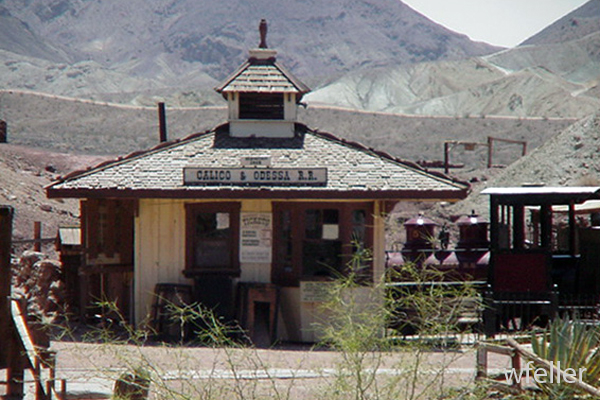
The Calico and Odessa Railroad is a narrow-gauge tourist railway winding through the stark hills of Calico. Built in 1954 by Shafe-Malcom Enterprises during Walter Knott's restoration of the weathered mining town, it draws its name from both Calico and the rugged chasms of nearby Odessa Canyon.
Unlike many historical tourist railroads, the railroad is not an original mining line, nor does it follow the roadbed of one. Instead, it is better understood as an interpretive railroad built to recall the small industrial lines that once served the Calico Mining District.
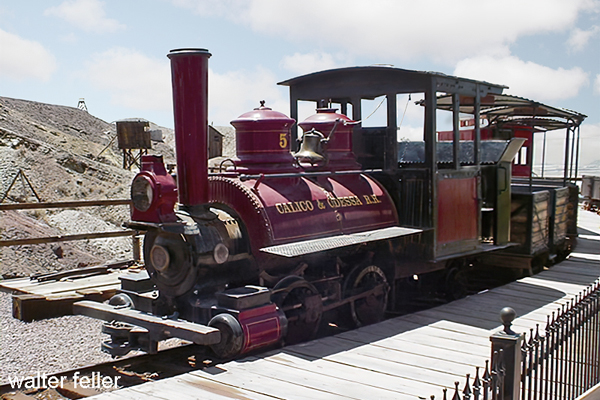
A Railroad for Visitors
The Calico and Odessa operate over a short loop through the hills near town. Its small diesel-powered locomotive is built to look like an old steam locomotive. Passenger cars carry visitors past mining remains and provide views of the surrounding district.While the railroad differs from the former mining lines, the modern route winds through dramatic landscapes and is built primarily for sightseeing. Its sharp curves, slender equipment, and narrow tracks vividly illustrate how nimbly narrow-gauge railroads tackled the rugged mining country.
The Historic Waterloo Railroad
Turning to Calico's mining era, the railroad most closely associated with this period was constructed in 1888 by the Oro Grande Mining Company. After the company's properties were sold in 1889, it became known as the Waterloo Mining Company Railroad.The three-foot-gauge line wound from the mouth of Waterloo Mine, its rails gleaming beneath desert sun, to the company's stamp mills atop Daggett Mountain-sometimes called Elephant Mountain-rising above the Mojave River. One gritty branch veered to the Silver King Mine, threading below Calico where Wall Street Canyon sprawls open to the sky.
More reliable than swaying mule teams, the railroad hauled loads of lustrous silver ore via treacherous terrain. Yet, its tracks never dared cross the moving sands of the Mojave River or pierce the heart of Daggett itself.
Later Borax Operations
Despite a decline in silver operations during the 1890s, portions of the railroad returned to use. Beginning in 1899, D. D. Connell and Marcus Pluth leased the Waterloo properties and resumed limited mining and rail operations.Later, the American Borax Company commandeered about a mile of these rails, sending borax shipments rumbling from the parched lands near Lead Mountain. While the torn-up track vanished in 1903, the borax line held on to life for several more sun-bleached years.
This operation was separate from the Borate and Daggett Railroad, which provided service to the borax camp at Borate in Mule Canyon.
What the Modern Railroad Represents
The Calico and Odessa Railroad may not preserve original Waterloo track or relic engines, but it conjures up the character of those scrappy mining lines. Riding it today, visitors feel the pulse and grit of the past, ringing across barren hills as ore once rattled towards distant mills.The modern train is therefore not a surviving nineteenth-century mining railroad. It is a mid-twentieth-century attraction that recalls the machinery, appearance, and purpose of Calico's earlier industrial railways.
References: San Bernardino County Calico History Q&A and PacificNG: Calico Railroad.