Irateba
A Mohave Leader on the Colorado River
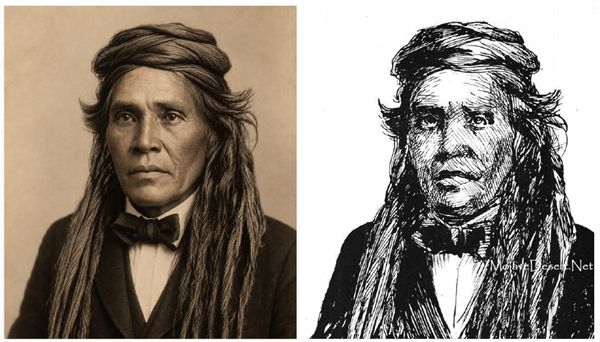
Ai regeneration (left) - Original drawing of Irataba (right)
Irataba, also spelled Irateba in early records, was a leading Mohave figure during the difficult years when United States expansion reached the Colorado River valley. Born about 1814, he lived in the Mohave homeland along the river near present-day Needles and Fort Mohave. He was remembered as a capable warrior, guide, speaker, and negotiator. His life cannot be understood as a simple story of cooperation or resistance. He worked to protect Mohave people and land while facing armed military pressure, new roads, mining camps, and a rapidly growing settler population.
The name Irataba is commonly explained as deriving from a Mohave expression meaning "bright bird" or "beautiful bird." Contemporary writers often focused on his large stature and calm manner, but those descriptions tell only part of the story. Irataba was important because he understood the new danger facing his people and became one of their principal representatives in dealings with explorers, soldiers, officials, and neighboring nations.
Guides and Explorers
Irataba and another Mohave leader, Cairook, assisted several American expeditions. They helped Lorenzo Sitgreaves in 1851, Amiel Whipple in 1854, and Lt. Joseph C. Ives during the 1858 Colorado River expedition. Ives traveled upriver aboard the small stern-wheel steamer Explorer to examine the Colorado and its canyons. Irataba and Cairook served as guides and intermediaries, helping the expedition move through Mohave country and communicate with other Native people.These early meetings were not casual encounters in empty country. The Colorado River was the center of Mohave life: a place of villages, irrigated fields, travel routes, trade, and sacred memory. American explorers were looking for routes by which more settlers, freight, soldiers, and miners could enter the Southwest. Irataba understood that these expeditions were part of a larger change.
The Rose-Baley Party and the Mohave War
In 1858, the Rose-Baley emigrant party crossed Mohave land near Beale's Crossing with about twenty wagons, roughly one hundred people, and a large herd of cattle. Stress had been building along the river. Travelers cut cottonwood trees, took resources, and expected passage through Mohave territory. Conflict followed.Older accounts commonly called the attack on the emigrant party a "massacre" and portrayed it as an unprovoked raid. That description leaves out the setting. One settler was killed, while seventeen Mohave warriors were killed by gunfire. Irataba did not take part in the attack. The event nevertheless gave the United States Army an excuse to impose control over the Mohave Valley.
Col. William Hoffman entered Mohave country late in 1858 and returned in April 1859 with a much larger force. The Mohave faced soldiers, artillery, and the prospect of further destruction. In the resulting agreement, they were forced to permit American travel through their land. The Army established Fort Mohave near Beale's Crossing and demanded hostages. Cairook, Irataba's son Tekse thume, Irataba's nephew Qolho qorau, and other Mohave men went to Fort Yuma as prisoners.
Cairook was killed during an escape attempt in 1860. The following year, Maj. Lewis Armistead's soldiers attacked Irataba's home and bean field after a dispute involving the Army. Mohave accounts remembered the ensuing daylong fight as a massacre. These events show the conditions under which Irataba had to make decisions: military occupation had replaced the earlier period of exploration.
Leadership Throughout Pressure
American officers and newspapers often called Irataba the "chief" of the Mohave. That title is incomplete. Mohave leadership did not operate like the Army's chain of command. Homoseh quahote, of the Malika clan, was the hereditary leader of the Mohave nation. Irataba, of the Neolge clan, became an important elected or situational leader because of his ability to deal with the new circumstances.The two men represented different, but not necessarily opposing, responses to American encroachment. Homoseh quahote remained associated with the Mohaves who stayed in the Fort Mohave area. Irataba became the chief representative of those who chose to work with federal officials to secure a future farther downriver.
Journey East and the Colorado River Reservation
In 1864, Irataba traveled with Indian agent John Moss to San Francisco, New York, Philadelphia, and Washington, D.C. He met President Abraham Lincoln and other federal officials. Newspapers made him a celebrity, often treating him as a curiosity and describing his appearance in patronizing language. The trip was intended to impress him with American power, but it also gave him a chance to speak for his people before national officials.After his return, Irataba worked with Arizona superintendent of Indian affairs Charles D. Poston on plans for a reservation near Parker. President Lincoln created the Colorado River Indian Reservation by executive order on March 3, 1865. Poston promised that irrigation would make the lower river land productive for Mohave farming.
A large Mohave group, often estimated at 800 people, followed Irataba south to the new reservation. Many others remained near Fort Mohave under Homoseh quahote. The move divided the Mohave nation into communities centered at Fort Mohave and the Colorado River Reservation. The promised irrigation system did not arrive, and the new reservation proved a hard place for an agricultural people. Still, Irataba remained leader of the Colorado River Mohaves and continued to represent them in dealings with the United States and neighboring peoples.
Later Years and Legacy
Irataba remained active in regional affairs during the late 1860s and early 1870s. Newspapers of the period often turned his conflicts, travels, and mourning customs into entertainment for distant readers. Read those accounts carefully. The familiar tale that Irataba returned from the East only to be dismissed by his own people is not a satisfactory history. His influence was likely greatest just after that journey, when he helped lead a substantial Mohave community to the Colorado River Reservation.Irataba died in May 1874, probably on May 3 or 4. The cause of his death is uncertain. Mohave people observed traditional mourning and cremation rites, and his nephew Qolho qorau succeeded him as leader at the Colorado River Reservation.
His heritage remains complicated. Irataba worked for peace, but an expanding government backed by soldiers and forts demanded it. He helped establish a continuing Mohave homeland on the lower Colorado River, while the reservation movement also divided a nation already under great pressure. Today, his name remains connected to the Colorado River country and to the Mohave people, whose descendants continue to live there.
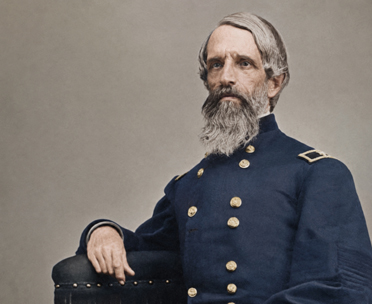
Colonel Hoffman
Mohave Indians
Fort Mojave
Lorenzo Sitgreaves in 1851
Amiel Whipple in 1854
Lt. Joseph C. Ives
Rose-Baley Wagon Train
Hoffman Establishes Fort Mojave
Marengo District Mines
Mojave Desert Mining History
Needles, CA.