The Institution of Slavery
The institution of slavery has had wide distribution in time and geography and in technique. It has existed throughout the world,
involving all races over a period of many thousands of years. This inhumane, yet human, institution existed in North America before
the continent was discovered by the Spanish-speaking people in the fifteenth century. The American Southwest had a history of slavery
(and some unique features of human bondage) during the Indian, Spanish, Mexican, and American periods. An important area and link in
the slave trading in the southwest was the Mojave Desert with its ancient Mojave Indian Trail{map} (1), a route that actually stretched
beyond the confines of the Mojave Desert itself. It went from east of the
Colorado River
to the
Mojave River
and across the
San Bernardino Mountains
to the Pacific Ocean.
The Mohave Indians at one time occupied parts of both the Mojave River and the Colorado River, but later resettled in
several villages (where?) {another good place for a map} along the Colorado River. Here they became adept at raising
muskmelons, watermelons, corn, beans, crude wheat, and even cotton. They became middlemen in a trade that extended from
the Hopi pueblos in Arizona and New Mexico to the coastal Indians around the present cities of Santa Barbara, Ventura,
and San Gabriel. The network of routes had a branch that went as far north as Bakersfield, where the enterprising Mohave
went to trade (2). A branch of the Mojave Indian Trail later became part of the
Old Spanish Trail
and still later part of the Salt Lake City-Los Angeles road of
"49er"
fame.
In order to visualize the ancient trade system of the Mohave Indian, one must read the accounts of the Spaniards who entered the
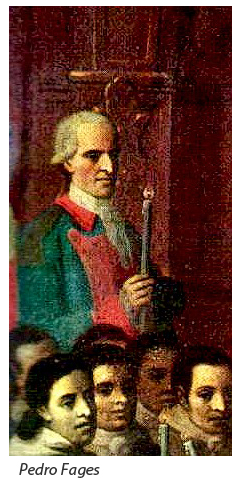
Mojave Desert. The first Spaniard who entered the Mojave Desert was
Pedro Fages
in 1772, who was looking for
runaway soldiers and unhappy neophytes who were not slaves per se, but were sometimes used for involuntary colonization and
service. (3) Little is known of Fages' experiences in the Mojave Desert, but the second Spaniard who entered this desert fortunately
recorded his observations in his diary.
Fray Francisco Hermenegildo Garces
in 1776 traveled up the
Colorado River to the
Needles
area; and then with
Mohave Indian
guides he continued on the
Mojave Trail
over to the
Mojave River
and across the
San Bernardino Mountains to the San Gabriel Mission. Father Garces
is credited with alerting California and Spanish authorities
to the importance of the Mojave Indian Trail.
Indian Slave Trade - NEXT >