Cahuilla Indians
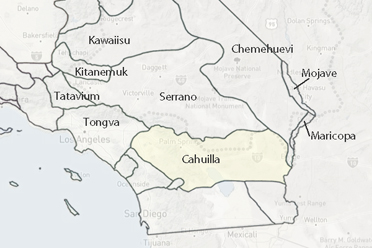
The Cahuilla are Takic [Uto-Aztecan] peoples arriving in southern California about 2,000-2,500 years ago. They were peaceful hunter/gatherer mountain and desert cultures. They ranged over the entire San Bernardino basin, the San Jacinto Mountains, the Coachella Valley, and portions of the southern Mojave. Their northern neighbors were the Serrano, and the Chemehuevi to the northeast. They lived in independent clans of approximately 600-800 people controlling their own separate territories.Material Culture, Technology
The Cahuillas hunted with throwing sticks, clubs, nets, traps, dead falls with seed triggers, spring-poled snares, arrows (often poison-tipped) and...Trade, Exchange, Storage
The Cahuilla used huge basketry granaries set on poles for storing acorns, mesquite beans, screw beans, and other ...Social Structure
Cahuilla clans belonged to either Wildcat or Coyote moieties, which were exogamous, non-political, and ...Religion
-
World View
The Cahuilla believed that they lived in a systematic, but unpredictable, universe, in which one could maintain existence only by ...
-
Spiritual Reciprocity
Reciprocity was an important value in Cahuilla rules for living. Not only were humans to give and receive freely in relationships with each other, but ...
History
-
Early History
Mukat's People (1972). Archaeological data suggest that they have occupied their traditional territory in the central part of the southern California area ...
-
The Arrival of Europeans & Anglo-Americans
The arrival of the Spanish and Mexicans in southern California in 1769 may have pushed them further ...
-
Gold
In 1874 gold and silver was discovered in the vicinity of Twentynine Palms, bringing it about that numerous ...
-
Reservations
Reservations began to be established for Cahuillas in the 1870s. The nearest of these to the Joshua Tree National Park was Morongo Indian Reservation, first permanently established in 1877. ...
-
Fiestas
Indian agents, not understanding the important role of the ceremonial events that came to be known as fiestas, tried to bring them to an end. This was so serious a ...
-
1920s & 30s
Cahuillas were very active in the 1920s and 1930s in the struggle to resist the allotment of reservation land to individual Indians, but ...
-
World War II & Beyond
Cahuillas served in the armed forces, and worked in war industries during World War II, and thereafter moved more rapidly into the mainstream of ...
Timeline
1774 The first encounter with Europeans was when Juan Bautista de Anza Expedition was looking for a ...Traditional Territory
In the Claims Case, the Cahuilla claimed the following: ...Major Sources
>> Next >>
from;THE NATIVE AMERICANS OF JOSHUA TREE NATIONAL PARK AN ETHNOGRAPHIC OVERVIEW AND ASSESSMENT STUDY
by Cultural Systems Research, Inc. August 22, 2002;